
Founder-led enterprise advisory

Make the right bets. Make execution move. Put AI where it creates real value.

Execution Clarity helps enterprise technology and GCC leaders decide what deserves investment, fix where execution breaks, redesign high-friction workflows, and govern AI without turning the answer into another layer of bureaucracy.

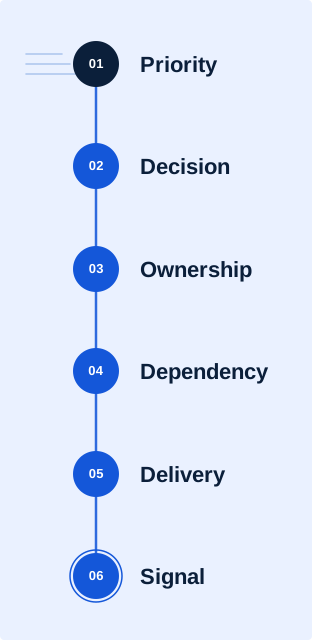
Execution flow: Priority → Decision → Ownership → Dependency → Delivery → Signal
Rajesh Sharma, Founder of Execution Clarity
Built from 21 years of enterprise technology experience, including nearly 19 years at McKinsey & Company.
Why these problems persist

The symptoms look different. The root causes repeat.

Across portfolio, execution, workflow and AI programmes, the same structural gaps keep resurfacing.

Priorities are disconnected from capacity.

Leadership adds commitments faster than funding, skills and sequencing decisions are revisited.

Decision rights are spread across too many forums.

Teams move, but final calls wait for escalation because ownership is unclear or duplicated.

Dependencies and handoffs surface too late.

Cross-team, vendor and platform constraints become visible only after delivery is already at risk.

Work is automated before it is redesigned.

Technology speeds up weak workflows instead of removing unnecessary steps, exceptions or reconciliation.

Benefits are claimed before value is baselined.

AI and automation initiatives advance without clear ownership for realised capacity, cost, risk or service outcomes.

Governance arrives after deployment.

AI use, identity, authority, human oversight and evidence evolve faster than the operating controls around them.

Selected enterprise experience

Real operating problems, solved at enterprise scale.

These are internal-enterprise achievements from Rajesh Sharma’s career, not independent consulting client case studies.

Featured enterprise experience
600+
hours/year of leadership capacity released

Relevant to: Workflow, AI & Automation Value

Problem
Executive reporting and QBR preparation absorbed leadership time.
Intervention
Reworked the reporting/QBR workflow using automation and GenAI.
Result
Released more than 600 hours of annual leadership capacity.

Experience from Rajesh Sharma’s enterprise leadership roles, not an independent consulting-client case.

1,000+
products · 63+ initiatives

Portfolio governance at scale

Helped bring large technology portfolios and initiative demand into a more governable decision system, improving visibility, prioritisation and leadership oversight.

Relevant to: Portfolio & Investment Governance
79% → 99%
OKR compliance

Execution discipline that sustained

Improved OKR compliance from 79% to 99% and sustained it over two years through clearer governance, ownership and operating rhythm.

Relevant to: Execution Operating Model
33
findings closed · 13 High/Very High

Security and governance remediation

Drove closure of ISO 27001 findings, including 13 High/Very High.

Relevant to: AI Governance, ISO Readiness & Operational Controls
Where I help

Five entry points. One coherent execution system.

The first three are core advisory pillars. AI Governance is a specialist capability. AI Agent Value is a focused decision lens that helps avoid expensive, low-value AI bets.

Flagship

Execution Operating Model & Transformation

For approved priorities that still stall in decision bottlenecks, ownership gaps, dependency friction and reporting noise.

  • Decision rights and escalation
  • Priority-to-delivery flow
  • Governance rhythm and execution signals
  • 90-day transformation roadmap
Explore the flagship →

Strategic Portfolio & Investment Governance

For leaders who need a defensible way to decide what to fund, protect, accelerate, defer or stop.

  • Portfolio diagnostic and prioritisation
  • Capacity and scenario analysis
  • Decision rights and benefits ownership
  • Executive decision pack
Explore portfolio governance →

Workflow Transformation, AI & Automation Value

For high-friction work where redesign, deterministic automation or AI could create measurable operational value.

  • Workflow diagnosis and redesign
  • Automation vs AI decisioning
  • Human + AI operating design
  • Benefits baseline and pilot charter
Explore workflow transformation →
Specialist capability

AI Governance & ISO Readiness

For organisations that need clear accountability, control design, evidence and readiness as AI enters enterprise workflows.

  • AI accountability and inventory
  • Human oversight and control design
  • Risk, impact and readiness
Explore AI governance →
Decision lens

AI Agent Value & Use-Case Prioritisation

For leaders asking a more important question than “Can we build an agent?” — “Should we?”

  • Use-case and workflow triage
  • Automation vs AI vs agent comparison
  • Economics and human authority
Explore the AI Agent Value Gate →
All capabilities

See the wider capability map

Reporting automation, automation reliability, portfolio resets, fractional transformation support and other focused modules sit beneath the five entry points.

View the capability architecture →
How the work connects

Prioritise. Operate. Transform work.

These are related but independent entry points. The offers are deliberately connected, but none requires the others.

01 · PRIORITISE

What deserves investment?

Make trade-offs explicit across value, capacity, risk, timing and evidence.

02 · OPERATE

How should approved work move?

Design decision rights, governance rhythm, ownership, dependencies and execution signals.

03 · TRANSFORM WORK

Where should work change?

Eliminate, simplify, automate, AI-augment or agent-enable only where the economics justify it.

Governance is applied where it matters. AI governance and operational controls are specialist capabilities that attach to portfolios, operating models or workflows when the risk and accountability profile requires them.
A distinctive decision capability

The best AI-agent decision is sometimes not to build the agent.

Execution Clarity evaluates the work first: does the workflow need to exist, can deterministic automation solve it, does AI improve the economics, and what human authority must remain?

“Agent” is not the strategy. Value, control and operating fit are.

See the AI Agent Value Gate
Value / EconomicsRisk / ControlHuman Judgment

The right decision can stop here. Move further only when the evidence supports it.

  • IGNORE

    Does this workflow need to exist? Do not automate waste.

    Stop if there is no useful work to preserve.
  • SIMPLIFY

    Eliminate or simplify the work before adding technology.

    Stop if redesign solves the problem.
  • AUTOMATE

    Use deterministic automation where rules are stable: cheaper, easier to test, easier to control.

    Stop if stable rules are enough.
  • AI-AUGMENT

    Use AI where judgment or unstructured information matters, only if the data and evaluation model are credible.

    Stop where human judgment must remain.
  • AGENT-ENABLE

    Use an agent when multi-step action adds value. Bound autonomy, permissions and exceptions.

    Proceed only if autonomy is justified.
Prove the economics

Benefit minus build, run, support, exception and change cost.

Check run cost, exception rate, risk and the human authority that must remain.

How engagements work

Start small enough to learn. Expand only when the evidence supports it.

Diagnose

Establish the problem, evidence, baseline and decision boundary.

Design

Build the operating model, workflow, decision system or controls.

Pilot / Embed

Test the change in a bounded real-world context and measure before/after.

Advise / Sustain

Support governance, adoption, value tracking and executive review where ongoing senior guidance is useful.

Engagements can use the phases that the problem requires.

Why Execution Clarity

Senior judgment, directly applied.

Founder-led

From diagnosis through recommendation, the senior adviser shaping the work stays directly involved.

Evidence before framework

Start with the actual decision, execution or workflow constraint before selecting a method.

Tool-neutral

Use AI, automation or another platform only where it improves the economics, control and operating outcome.

Rajesh Sharma, Founder of Execution Clarity
Founder

Rajesh Sharma

Rajesh is a transformation and enterprise execution leader with approximately 21 years of experience, including nearly 19 years at McKinsey & Company. His work has spanned technical program management, service delivery, Agile and product ways of working, IAM/security, DevSecOps, reliability, OKR/QBR governance and AI-enabled automation.

Execution Clarity brings those experiences together into a focused founder-led advisory practice for enterprise technology, GCC and transformation leaders.

Start with one problem

Bring the initiative, workflow or execution problem that is hardest to make clear.

The first conversation is about the problem and whether there is a useful, bounded next step — not about forcing a pre-packaged engagement.

sharma.rajesh0809@gmail.comOpens your email app. You can also copy the address.